This blog is part of the courses on film, art, literature, and media
given by Dr.
Hudson Moura, Toronto, Canada.

Saturday, April 15, 2017

The Successes and Pitfalls of a Video Campaign

Review of Chapter 10 "KONY 2012 Anatomy of a Campaign Video and a Video Campaign," Leshu Torchin.
Routledge Companion to Cinema and Politics, ed. by Yannis Tzioumakis and Claire Molloy


By Chiara Lucchetta

A crucial part of the film process has always been promotion and distribution: determining what platforms to advertise on and how to invite an audience’s attention over to a film. Along with ensuring a film’s content will capture and hold its audience’s attention, the film industry must be clever with how it can make its films widely and publicly known. Therefore, it comes as no surprise that in a rapidly expanding digital world, the film industry has latched onto social media platforms as gateways into the public’s homes. Social media has become a powerful tool in the world of film, and even more instrumental to the merging of film and politics. Whereas, before, politicians made videos to aid in their campaigns, there are now campaigns built on films. These video campaigns spread fast and far, going viral online and trending worldwide. One of the most notable video campaigns of our time is Kony 2012.


The Kony 2012 campaign started with an experimental video, produced by Invisible Children (IC) and directed by Jason Russell, the founder of the Invisible Children organization. This campaign video was meant to expose the crimes of Joseph Kony, the leader of the Lord’s Resistance Army (LRA), in Uganda, and incite people to take action – two goals that are controversially viewed as being successfully met. However, what was clearly viewed as a success of Kony 2012 was how quickly and vigorously the video campaign spread. The components that went into the broadcasting nature of this advocacy film campaign are discussed in the article “KONY 2012 Anatomy of a Campaign Video and a Video Campaign”, written by Leshu Torchin. However, while Torchin’s analysis of Kony 2012 examines the role of the advocacy film within the context of online media, it does not take a definitive stance on the moral successes or pitfalls of such a video.

Where one can look at the Kony 2012 initiative arguing either side, Torchin (2016) instead chooses a reflective viewpoint, encouraging the campaign to be regarded as a learning experience, which “offers an occasion for thinking about the benefits and limitations of video advocacy as it moves online” (p. 123). Torchin begins with this thesis that Kony 2012 prompts us to thoroughly consider how the evolving online world will change how we think about, and go about, curating, promoting, and distributing advocacy videos. As Torchin launches into the article with data about the life of Kony 2012, the changing relationship between film and online media, which the reader has been called to consider, becomes apparent.

To better understand the context of the campaign, Torchin delves into the teleology of IC and how and why Kony 2012 came to be. It is important to note that IC is no stranger to video activism (Torchin, 2016, p. 123). Founded in 2004, with the goal of shedding light on the use and abuse of child soldiers by the IRA, IC produced a number of documentaries before Kony 2012  (Torchin, 2016, p. 123) Therefore, when IC entered into the Stop Kony project, the organization already had a strong idea of the power and impact films could have on a public, online platform, and definitely the potential of ‘clicktivism’. Torchin (2016) briefly confronts this concept of clicktivism in relation to IC’s strong belief in the leverage of social media, suggesting that critics of this activism tool underestimate it (p. 124). Clicktivism, as described by Mark A. Drumbl (2012) in his article “Child Soldiers and Clicktivism: Justice Myths and Prevention”, is when organizations use social media to advocate for a cause and get people involved (p. 481). Drumbl (2012), whom Torchin references in her article, debunks clicktivism, and by direct association the Kony 2012 campaign, for having “short attention spans and limited shelf life” (p. 484). That is to say that they hold no real influence in the long run, which is an interesting opinion to consider when examining the outcomes of the Kony 2012 initiative. However, the content of the video and what went into making it must be understood first before one can look at its aftereffects.

Providing scene-by-scene descriptions of the video, Torchin does an excellent job of breaking down the film’s plot line and the meanings behind its composition. Kony 2012 is narrated by activist Jason Russell, who also takes on the role of the film’s lead. The campaign video is composed of shots of Russell explaining the crisis in Uganda to his five-year-old son, Gavin, revealing the story of turmoil of his Ugandan friend Jacob, and outlining ways people can take action, such as through “Cover the Night”, a night devoted to posting up pictures of Kony. Throughout the film, there is a persistent, underlying theme, which praises social media. As Torchin (2016) states, “These [social media] platforms…can function to articulate the relationship of the user to the world, and of the humanitarian to the person in need” (p.130). Torchin (2016) even lays out the history of sites like Youtube and Citizen Tube popping up as channels to be used to advocate for causes (p. 124-125). This motif that social media can connect the world, further leading to change, seen in the recurring graphics of social media sites in Kony 2012, is the framework through which Torchin analyzes the film.
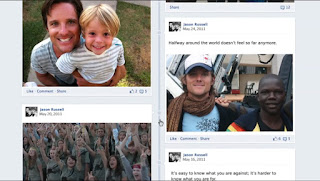


Torchin (2016) points out that there is this conviction driving Kony 2012 that exposure to an issue will lead to awareness, which will ultimately lead to a response of action (p. 124). And so, Kony 2012 mirrors something of a publicity campaign; “as Russel explains in voiceover, the goal is to make Kony ‘famous’, a process that will lead to his capture” (Torchin, 2016, p. 124). This conviction is carried on throughout the video, as seen when the audience is told in order to help, they must share the video with their friends by the means of social media.  As Torchin  (2016) explains, targeted towards the very specific audience of modern, progressive young adults and students, the film prospered in this respect, receiving 112 million views in just 6 days (p. 123). However profitable a response the video received though, Torchin (2016) also makes it clear that, unlike the film’s structure suggests, there is not a direct correlation between engaging in social media posting and democratic change (p.127).

This is a recurring point made in Torchin’s article. As Kony 2012 displays seamless scenes of the engagement in social media leading to Kony’s capture, the audience is guided to believe that it can be this easy (Torchin, 2012, p. 126). Furthermore, this contributes to a larger source of criticism regarding the film, and that is oversimplification. Torchin (2016) calls attention to these questionable film techniques in passing, saying that in explaining the issue in simplest terms and by placing the audience on the intellectual level of a five-year-old boy, the issue wrongfully turns into “a ready-to-comprehend battle of good versus evil” (p. 127). Torchin then continues on to also present preexisting criticisms surrounding the film for its underrepresentation. Not only does the film misconstrue the issue in Uganda for its audience through simplification, but also through its lack of voice from Ugandan politicians, activists, and citizens, (Torchin, 2016, p, 127). Nonetheless, Torchin (2012) passes over these judgments, saying these film choices follow with IC’s campaign strategy and actually aid in its progress as they support the American image of the “White Saviour” complex (p. 126).  Thus, moving on, Torchin again looks at the role of social media in an online video campaign. Torchin (2016) admits that the video was ineffective in getting people involved in actual, practical initiatives, however, says this does not weaken the potential of social media campaigns, but “raises questions of how activists negotiate the speed and reach of these new media, particularly when assessing the timeline of a campaign” (p. 129). Finally, Torchin (2016) concludes the article by reaffirming her view that Kony 2012 teaches us how film and social media can work together to promote activism (p. 131).

By the end of this article, Torchin both presents praise for Kony 2012 for showing the potential reach a video/social media campaign can hold and presents critiques over the content of the video. Unfortunately, scrutiny of what was displayed in Kony 2012 (and how it was displayed) is overshadowed by Torchin’s breakdown of how the video approached the world of online campaigning both on and off the screen. In her article, Torchin focuses more on learning from Kony 2012 how to use and connect an online video campaign with practical action than on the ramifications of the film’s makeup. In her conclusion, Torchin (2016) “prompts us to ask how one can engage an audience without resorting to excessive oversimplification, or narcissism of pity that engages politics of victimization and occludes local agency and voice” (p. 131); yet, fails to start this conversation herself in the article. I believe these ethical dilemmas, which the video raises, as well as the consequences of the video campaign’s more controversial film techniques, could have been explored more thoroughly. I agree that as a campaign video, Kony 2012 broke boundaries with the amount of attention and passion it spurred. I also think the emphasis Torchin places on studying Kony 2012 as not just a video, but a movement, is important to understanding it since “video and publicity function as components of a larger campaign” (Torchin, 2016, p. 124). However, the negative features of the film are ones that could have had a dangerous impact on Western political culture, and therefore needed to be delved into more deeply. Kony 2012 did a good job of capturing its target audience’s attention, but in doing so, it also fed into Western political ideals that place America as the centre of the world. Or, as Torchin (2016) recognizes, but does not address, “maintains power and agency in the body of white men” (p. 126).

We have learned in this class that films can shape how we think about the world and ourselves. Therefore, it is important to pay attention to what a film is telling us. Kony 2012 may have begun with sincere intentions to advocate for the rights of children in Uganda. Somewhere along trying to spark excitement in its audience though, the subject of the video (victims in Uganda) became lost. Kony 2012 became less focused on revealing an issue and more focused on placing Western civilization on a pedestal. This issue is one Torchin (2016) recognizes in her article when she talks about the victims in Kony 2012 becoming obscured by the Hollywood dynamics of the video and the “dramatic arc of activism” (p. 127). What Torchin does not do though is talk about the repercussions of this. It seems to me that in attempting to prove that Kony 2012 acts as a lesson on how to use film and social media as accompaniment for activism, some of the more problematic parts of the video are overlooked in the article. As discussed before, Torchin (2016) regards the lack of African representation in the film as a strategic ploy to hook young activists by confirming the meliorism to which they feel a responsibility to (p. 126). I agree that this probably had a hand in why the video did resonate so well with students, gaining a profitable following. However, I think the article should have been more critical of the implications that come with feeding into this preexisting belief, even if it is for a good cause.

When defining IC’s social media campaign plan, Torchin compares it to the approach of the human rights organization WITNESS, who also use film and online communities as activism tools. All through her article, Torchin calls attention to how Kony 2012 applies video advocacy methods integral to WITNESS’ mission statement. According to the article “Juggling Advocacy, Audience and Agency When Using #Video4Change”, by Sam Gregory (2012), the program director of WITNESS, this statement includes the principles that videos “should be audience oriented and provide a clear space for action” and “should be part of a campaign, complementing other forms of activism” (par. 4). Torchin uses this comparison to strengthen her conviction that Kony 2012 stands as an example of how and what an online video campaign should look like. Nontheless, if you look more closely into the doctrines WITNESS stands by, you can see that Kony 2012 fell short of living up to the same ethical standards.

 Gregory addresses where Kony 2012 went wrong in exercising these advocacy tools in his article. For one, I noticed the video’s oversimplified narrative ends up misrepresenting the victims. Gregory (2012) characterizes storytelling as being too simple “when it perpetuates stereotypes” (When Does Storytelling for an Audience Make Simple Too Simple, par. 5) , and this is what Kony 2012 does. As we have seen, Torchin does touch on this exhausted dichotomy of the suffering, vulnerable African and self-assuring White man evident in Kony 2012; however, she does not respond to how asserting this stereotype contributes to us viewing Africa as inferior to us. Another complication that I noticed with the narrative is its runtime. Torchin (2016) claims “The video’s runtime allows for a lot of information and the development of a clear narrative”, as the video has a runtime of 30 minutes, compared to the typical 30 seconds used for advocacy advertisements (p.124). Looking back at the film conventions used by WITNESS, this runtime appears to be an advantage since it provides IC with room to develop an engaging storyline for its audience. Be that as it may, the video’s length suggests it is something that it is not. Because Kony 2012 is long enough to establish a narrative, it fools its audience into thinking it is a documentary about the crimes of the LRA, when there are few accurate facts about this subject included. Again, Torchin confronts this criticism in her article by then turning it around to be regarded as productive discourse. According to Torchin (2016), these mistakes lead to constructive feedback, such as in the form of “Uganda Speaks” and the ‘#AskIcAnything’ initiative (p. 130). “Uganda Speaks” was an online platform where Ugandan voices could join in the conversation about the issue and contribute facts about their experiences; whereas, IC opened themselves up to questions and criticism online using ‘#AskIcAnything’ (Torchin, 2016, p. 130-131). Similar to Torchin, I see how these responses to the criticism IC and Kony 2012 received resulted in more constructive and transparent exchanges over the conflict in Uganda. However, I would have rather the article explore where the video went wrong and how future online campaign videos can practice better ethics than on how to correct the matter after the fact.

Finally, the greatest weakness I found with this article was the absence of evidence for Torchin’s most repeated conviction, which is that you can learn how to use online video to complement real-life action for change from Kony 2012. As both Torchin and Gregory reiterate, an online advocacy video is only effective when working as part of an off-screen campaign (Torchin, 2016, p. 131). Kony 2012 did institute other activist events, such as “Cover the Night” and encouraging people to bring the issue to the eyes of influential figures in politics and pop culture on Twitter. Yet, these off-screen activities did not see much movement. Torchin (2016) does not see this as a failure of the video, but rather the result of its success as it spread fast immediately instead of gradually increasing attraction leading up to “Cover the Night” (p. 129). I think it is interesting to return back to the concept of clicktivism here though, and consider if the reason for this failure is that the instantaneous, fleeting nature of viral videos does not allow for longer, sustained interest. Based on the way the video was dramatized to seduce and persuade, which Torchin discusses, it is not far off to think that people adopted Kony 2012 as a trend instead of a serious issue, causing the short turnout for “Cover the Night.”


With this article, Torchin gives the reader much to think about concerning Kony 2012. It is for this reason, however, that I think there were areas that could have been scrutinized more. Torchin expertly paints a picture of what a successful video campaign can look like using Kony 2012 as a learning example, but it is within this example that there are gaps. In this article, Torchin brings forward criticisms of the video that can be used to create conversation over how to craft video campaigns to circulate as much attention as Kony 2012, but under more ethical pretenses. Thus, I left this article asking myself the same question, but also wishing Torchin would have given her own input on how to best approach film in a developing online world.

References

Drumbl, M.A. (2012). Child soldiers and clicktivism: Justice, myths, and prevention. Journal of Human Rights Practice. Vol. 4. Retrieved from http://works.bepress.com/mark_drumbl/77/
Gregory, S. (2012, March 17). Kony 2012: Juggling advocacy, audience and agency when using #video4change. Retrieved from https://blog.witness.org/2012/03/kony-2012-juggling-advocacy-audience-and-agency-when-using-video4change/  
Torchin, L. (2016). KONY 2012 - Anatomy of a campaign video and a video campaign. In Y. Tzioumakis, & C. Molloy (Eds.), Routledge Companion to Cinema and Politics. (pp. 123-134). Routledge.

Representations of Working Class and Film as a Pedagogic Tool


Review of Chapter Nine: "Film and the Politics of Working Class Representation: The Inside Film project," Deirdre O’Neill
Routledge Companion to Cinema and Politics, ed. By Yannis Tzioumakis and Claire Molloy


 By Amanda Donaldson


Social class and the division of the classes has become something we avoid talking about, for more pressing issues. Our capitalist society is built on a hierarchal system that places the people with the means of production in a higher class while placing the labourers who sell their labour to the upper class in a lower fraction: the working class. In her chapter Film and the Politics of Working Class Representation: The Inside Film project, Deirdre O’Neill seeks to examine and discuss the ways in which negative and positive representations can affect the subjectivities of members of society, with a focus on its effects on working class people. O’Neill frames her work with theories of class structure within our capitalist society and how our subjectivities are developed and shaped by environment. O’Neill hypothesizes that film can be used as a radical pedagogic tool, and she examines the benefits of the medium through the lens of The Inside Film Project and its work with prisoners and ex-prisoners (O’Neill, 2016, 112).

O’Neill’s piece begins with a brief introduction to the topics and subjects that will frame her arguments throughout the rest of the chapter, specifically the “questions of subjectivity and representations as they relate to the working class” (O’Neill, 2016, p. 112). She goes on to introduce The Inside Film project as her lens for her study, and she describes it as a project that “works with a specific group of people (prisoners and ex-prisoners) in a particular set of circumstances (in prison or on parole)” (O’Neill, 2016, p. 112), and it explores how film can foster “a critical engagement with society in ways that more traditional academic subjects are unable to do” (O’Neill, 2016, p. 112). O’Neill expresses that the students working on this project have complete creative control in the creation of their film – they script, storyboard, edit, and even act in their own pieces. However, even before the students get to engage in the filmmaking process, the students are provided with both the historical and theoretical frameworks they need to understand their own practice. The project emphasizes “the importance of self-representation for the working class” (O’Neill, 2016, p. 112) and O’Neill argues that this allows them to present accurate depictions of experiences specific to working class citizens, and to depict the values and attitudes of the working class as distinct from those of other classes. O’Neill continues to emphasize that the work of The Inside Film project will offer content that does not present the generalized, and often criminalized, stereotypes that can be found in the mainstream media, and the importance of this is something she will explore as the chapter continues.


            O’Neill research about the film medium and its outcome is dependent on an understanding of the Marxist theory of class to conceptualize and practice class-based radical pedagogy (O’Neill, 2016, p. 112). O’Neill’s work utilizes the Marxist idea that the model of the class is premised on the division of labour “wherein the working class sells their labour to the bourgeoisie who own the forces of production” (O’Neill, 2016, p. 113). She then begins to explain this theory in great detail, providing the reader with the background information necessary for understanding the rest of her argument. O’Neill explains that according to Marx, the two classes both oppose and interlock with one another, and the nature of the capitalist system in which they exist is one that is antagonistic and alienating and therefore creates not only struggle but the conflict between and within the classes. O’Neill then expresses an important point: “Consciousness of class is not necessary to experience class” (O’Neill, 2016, p. 113). The conflict and struggle will exist, even if the classes are not aware of it. Many working class people, as O’Neill showcases with the prisoners later in the chapter, find it difficult to differentiate between the ways in which society treats them, the way the media represents them, and the impossibility of the demands made of them by society. This inability to understand their predicament produces a cycle of deprivation, crime, and imprisonment, one that the working class finds themselves bound to and unable to reconcile (O’Neill, 2016, p. 115). They are then left with an incoherent subjectivity, something O’Neill explores later in her text. 

O’Neill’s chapter argues that projects like The Inside Film allow for working class people to create and engage with content that accurately represents them, rather than only having access to the stereotypes that they and the public are consistently presented with. O’Neill also points out that years of neoliberalism has “dramatically restructured the working class while the category has all but been erased from public discourse” (O’Neill, 2016, p. 113). She explains that this ideology has then “led to the removal of class as an analytical framework with the explanatory power to account for the individual and social pathologies we are currently witnessing in contemporary society” (O’Neill, 2016, p.113). It is not that class no long exists, rather neoliberalism has introduced and entrenched in our society a language that has masked the policies that are designed to reinstate and strengthen capitalist class power. (O’Neill, 2016, p. 113) She believes that pedagogic projects like Inside Film and their representations of class could help society to unlearn this language and can act as a catalyst for change.
After providing her reader with a detailed explanation of the Marxist model of class, O’Neill acknowledges that this theory did not allot for the growth of a professional middle class, one that stands between the working and capitalist classes. According to O’Neill, the middle class is separated from the working class by their cultural and educational ‘capital’ (O’Neill, 2016, p. 113). The middle class will also often occupy positions that place them in supervisory or authoritative roles over the working class. She states that this indicates that their experiences with capitalism are different from that of the working class. O’Neill’s argument, then, bases itself on this idea that members of the middle class and working class will live in and understand society in very different ways. She acknowledges that these classes contain various fractions, like “an affluent working class” (O’Neill, 2016, 114), which is why The Inside Film Project chooses to focus on prisoners and ex-prisoners. These students will often occupy positions in society that require limited education, and the work will be unskilled and carry a low income and low status. They will be presented with little to no opportunity for social mobility, will generally not own property, and will not make enough money to afford the basic necessities of living (O’Neill, 2016, p. 114). O’Neill emphasizes the inclusion of “the increasing numbers of working poor and the unemployed” (O’Neill, 2016, p. 114) within her study, because their experiences are “more likely to be distorted and silenced by a privileged middle class,” and this treatment, coupled with their treatment within the media, is what “condemns them to marginalization and silence and…from playing a participatory role in the public sphere” (O’Neill, 2016, p. 114). However, despite her focus on income and employment, O’Neill does not treat the working class as simply an economic category within her text – she considers the social, cultural, and political aspects of the class’s formation and experiences.  

To challenge the hierarchy of a capitalist society, O’Neill argues that there would first need to be a change within the working class subjectivity, specifically within the individual. Her work also looks at the effect of pedagogical practices on the construction of subjectivities, and their potential to alter them. In order to do this, O’Neill first examines the working class subjectivity, explaining that it “cannot be separated from the conditions under which it comes into being“ (O’Neill, 2016, p. 115) and that “our sense of self develops through personal, environmental and institutional social interactions [that are] directly influenced by our historically determinate class positions” (O’Neill, 2016, p. 115). Therefore, based on this knowledge, O’Neill explains that working class people will develop a subjectivity that is different from those who develop theirs under privileged circumstances. And it is these subjectivities that are critical to The Inside Film project’s aim to expose the ways in which the lives and experiences of working class people are misrepresented for political and ideological purposes. (O’Neill, 2016, p. 115). These representations are what create the incoherent and contradictory working class subjectivity mentioned previously. O’Neill recognizes that there is a possibility to change this, however, because the capitalist system relies on this structure, to change this hierarchy into something fairer would cause the system to collapse.

According to O’Neill, The Inside Film project seeks to highlight the effects that the mainstream media and its distortions of working-class life have on the participants of the project, and how those effects can be seen and shared amongst other members of the working class. The project allows for members of the working class to create content that equitably and accurately represents their experiences within a capitalist society. The specific example O’Neill uses is that of a project entitled Who Am I?. The film structures itself around questions of race, gender, and religion, and operates on levels of the subjective, the national, and the international. The questions are posed from the perspective of working class men serving prison sentences, and it examines their personal actions juxtaposed with the criminal actions of the wealthy and powerful (O’Neill, 2016, p. 117). Before the filmmaking process began, the students took part in a workshop on Third Cinema, which is a “low-budget, politically motivated cinema” that utilized radical strategies that reject the conventions of dominant filmmaking, like narrative linearity, continuity editing, and spatial and temporal logic (O’Neill, 2016, p.118). It had a massive influence on their work, because it allowed them to convey the anger and frustration they wanted in their piece, as well as cover a wider range of topics that their budget and time restraints otherwise would not have. The film attempted to look at the complex relationship between the media, politics, economics, and history, and how these interconnecting factors affect the construction of one’s identity. During the filmmaking process, many of the prisoners found that their experiences both in and out of prison overlapped, and that these conditions have shaped their identities in similar ways. From this, O’Neill is able to draw the conclusion that, although the medium alone cannot change the hierarchy in which society is structured, film can contribute to the conditions necessary to bringing about change. Film not only allows for a chance to change and shape individual subjectivities formed under capitalism, but it also can work as an educational tool for the public and can help to deconstruct the negative representations of the working class currently in the mainstream media.

Overall, O’Neill’s work examines the connection between subjectivity and representation (O’Neill, 2016, p. 114), and the effectiveness of film as a pedagogic practice. I found the chapter to be kind of interesting, however it was a little difficult to get through. I found O’Neill’s writing to be dry and a little dispassionate. Much of the content was based on explaining the theories surrounding class, rather than focusing on film as an educational tool. This examination did not come into her work until much later, and by that point, I was not as interested as I was when I initially began reading. The explanation of the Marxist theory of class and her descriptions of subjectivity was a necessary framework for her chapter, because readers without prior knowledge about such topics would not have been able to fully comprehend her argument, and therefore it would not have been as effective as it was. I do believe, however, that the chapter would have been more efficient if O’Neil had spent more time in looking at the film medium as an educational praxis, rather than spending the majority of the article focusing on explanations of class structures. I enjoyed O’Neill’s use of The Inside Film project as her lens for the topic. I believe it was a very impactful choice to use a film created by members of the working class in order to emphasize the importance of this kind of representation and the positive effect film can have on subjectivities when the content is a faithful and positive representation of its subjects. Through her explanation of the film’s premise, Third Cinema techniques, and specific scenes and themes from the film, I was able to really visualize the content of this piece. However I do believe it would have been even more helpful if there were a way to access this film. I think that if the reader were able to actually watch it, O’Neill would have had a stronger impact on her reader. It would also have been helpful if there was something to compare Who Am I? to, possibly a more mainstream movie that does not accurately represent the experiences of the working class the way that Who Am I? was able to.


This chapter began with an introduction to class theories, and O’Neill goes on to explain, in great detail, the Marxist definition of class and social structures. The chapter hypothesizes that it is possible to use film as an educational tool, with a specific focus on its use in representing the working class and its ability to shape and alter an individual’s subjectivity. O’Neill’s piece as a whole was extremely educational, and I learned a lot, despite the dry tone and heavy emphasis on history and sociological matters. The work was effective, but I believe it would have had a greater impact if O’Neill had spent more time focusing on the film medium, and by possibly including more accessible examples for her reader to relate to.


Works Cited
O'Neill, D. (2016). Film and the Politics of Working Class Representation: The Inside Film project. In Y. Tzioumakis & C. Molloy (Eds.), The Routledge companion to cinema and politics (pp. 112-122). Basingstoke: Taylor & Francis Ltd.

The Strive for Social Change


Review of Chapter 8: “Reel News in the Digital Age: Framing Britain’s Radical Video-Activists," Steve Presence


By Jessica Rondeau

Throughout history, there have been various controversial and political issues around the world that have been broadcasted via social media.  The purpose of broadcasting has always been to update civilians with significant events around the world ‑ to allow people to have a better understanding of various issues and conflicts.  These political issues are usually protests or other forms of aggressive campaigns where individuals attempt to get their voices heard by a higher power, typically the government.  The purpose of these protests is the result of unsatisfied people based on the overall social structure and culture they currently live in.  Therefore, the main goal is social change ‑ a revolution in society.  Activists are essential to progress and evolve within a societal framework.  Without it, society would be ignorant to anything outside our own set perspective, thus resisting any form of free speech.  Video-activism is a significant source of news within our society, and one that shows the true radicalism that takes place around the world.  “Reel News in the Digital Age: Framing Britain’s Radical Video-Activists” by Steve Presence focuses on Reel News, a video-activist broadcast based in London, and how it is the most unique source of video-activism to-date.  Presence reveals to the reader how anti-activism struggles throughout the advancements in technology, the history of Reel News and its inspiration, as well as why it is a key component within our society today. 

The article begins by discussing British video-activism and how the Internet along with thriving advancements in technologies have had a major impact on the distribution of news, both in a positive and negative way.  Video-activism is a left-wing collective with the objective to document radical and controversial issues mainly revolving around protest and identity, all with the broader aim to reach greater social change.  Presence discusses how video-activism’s place in the world has been radically altered by the widespread technological revolution, thus resulting in new forms of giving and receiving information. Essentially, these technological advances within our culture have changed our social structure, inevitably leaving video-activists to struggle in the economy.  Presence further provides examples of how people have access to any information at the touch of their fingertips without any cost.  A major example of accessing information is Wikipedia. (Presence, 2016, p.2) This well-known sight for navigating information is not yet completely exhausted, and still gives people insight to relevant, up-to-date news around the world without any barrier of paying expenses. Also, he states that “online platforms such as Youtube and Vimeo have vastly increased the potential audiences for oppositional filmmaking and created an immense archive of potential footage” (Presence, 2016, p.2).  Despite the upside of being able to further display videos and educate others through arising social media platforms, all information can be discovered for free by individuals just from searching on the Internet and this, therefore makes it harder for video-activists to earn money and make a living. (Presence, 2016, p.2) By including this, the reader sympathizes and has a better understanding of the benefits of the accessibility on the Internet versus the need for money.  Furthermore, considering video-activism covers radical and largely controversial issues, no one is willing to sponsor these videos because they would rather stay more conventional.  As a result, video activists do not receive any income while becoming invisible in the world of film. Presence finalizes this paragraph by stating Reel News is rather unique and rare as a video-activist collective because they could fund their own radical film productions.


In continuation, Presence further expresses how video-activism slowly began to make a statement in the world of film during the 1990s.  This is because during this time many people began to get themselves involved in protests for the anti-globalisation movement.  Presence states that in Britain during 1999, the global Carnival Against Capitalism “marked the beginning of this new wave of anti-capitalist protest.” (Presence, 2016, p.3) This heightened political awareness meant that most opinionated people wanted to be involved while others wanted to be up to date with the latest news regarding the protests; thus, the demand for radical news began to rise and so did British video-activism.  Presence further explains that during events like the “Battle in Seattle” - where there were various instances of police brutality ‑ people became intrigued and eager to find sources via social media to know what exactly happening in the real world. (Presence, 2016, p.3) Events like these ended up being quite revolutionary, and the main purpose or importance of British video activism in this case is that it captured the desire for social change and the power of the people during that timeframe through what is known as “Indymedia”.  What was so significant about these protests was that they became seriously vicious and violent.  The dramatization of these broadcasts was essential for British video-activists because they thought it would enable them to fully use the internet as an alternative source to get their footage out in the open.  Although the internet was considered an alternative source, it was not necessarily a popular way of receiving news at this time and did not become a prominent way of viewing things until years later.  (Presence, 2016, p.4) 

Throughout the next section of this chapter, Presence focuses more on how Reel News is funded, and what makes this particular video-activism collective truly one of a kind.  He clarifies that Reel News is “funded solely by donations” (Presence, 2016, p.4) He provides factual evidence of founder, Shaun Dey admitting that he has roots in the labour movement.  Because of this experience in trade-unions, his ideological framework is solely based on the idea that whatever money is earned is not taken away by a higher power from him or anyone else that works for Reel News.  Therefore, Reel News is dependent on donations so that it can function. (Presence, 2016, p.5) 

Shaun Dey eventually went on to continue his education by doing research on radicalism in the mid-1990s, which further opened his mind and influenced him to continue expanding his video-activism with Reel News later on. Presence further explains Dey’s story to help the reader understand the true inspiration and quality of Reel News itself.  In doing so, he explains that Dey was influenced to visit Latin America to see what a real “fight against neoliberalism” was. (Presence, 2016, p.5) He explains that Latin American countries had “non-Eurocentric perspectives, which both celebrated and was shaped by various movements and campaigns.” (Presence, 2016, p.4).  Argentina was the major influence for Dey, where he met Rick Rowley and Jackie Soohen from “Big Noise Films.” Presence articulates the connection and the inspiration aroused from Dey through this experience where he learned to make relevant and powerful films.  This influenced him to continue to produce various films for the public when he returned to Britain to create some sort of social change.  To the reader, it is evident that Presence really wanted to emphasize that Shaun Dey’s main goal in founding Reel News was to strive towards a certain sense of social change by exposing what is thought as controversial news.  This strive towards social change is important and revolutionary, and it is something that inspires others to act.  Presence emphasizes this point by quoting Dey when he talks about his experience seeing Bruckmen’s women, and how they struggle throughout their day-to-day lives to make a living.  (Presence, 2016, p.7) This essentially inspires him, showing him that it is possible to make Reel News an exceptional video-activist broadcasting. 

Near the end of this chapter, Presence includes a statement Dey expresses about training new filmmakers.  He feels as though in video-activism, it is more about the quantity than the quality ‑ the amount of political content is more important than the actual production value. (Presence, 2016, p.7) he further describes Reel News as “throwaway” filmmaking, because it is only useful for conventional media if it has a lot of political violence.  The author includes this for the reader to understand that popular media only wanted information that will capture the attention of their targeted audience within a short span of time.  This is significant because the majority of people today give off a certain reaction when they witness political violence on the news, and in turn it acts like a chain reaction where everyone else feeds off from one another without doing their own research or truly understanding the full story based on facts.  Stating this was essential for this article because it intensifies how people don’t take the time to do their own research or educate themselves to truly understand what is going on in the world around them.  Moreover, Dey states that “’without 100% editorial control I wouldn’t trust what they were going to do with [the footage,]’” like from the Reel News footage used by BBC in 2013 that ended up being misleading and out of context. (Presence, 2016, p.8)
 
In conclusion, Presence ends the chapter by wrapping up the idea on how Britain’s video-activism is falling behind in the digital age despite how far it has come.  Rogue Reels: Oppositional Film in Britain by Margaret Dickinson (1999) is a novel that discusses the issues on activism in Britain, and is one of the most current pieces of work based on this issue to date.  In saying this, there is a lot that has changed within the years in terms of advancement in technology.   This is because the work that is being produced today is very similar to the successful work that has already been done in the 1990s.  (Presence, 2016, p.8) Therefore, there is no evolution in the world of British video-activism.

Presence’s article is intriguing and was somewhat interesting to read.  However, in the beginning of the chapter where he talked about the rapid change during the digital age, it was challenging to keep up with what the main point he was trying to convey was.  It took a while to fully understand what his main point was while reading each paragraph, and I had to annotate each one as thoroughly as I could.  Furthermore, it was also slightly misleading throughout the chapter because he mainly talked about the how British video-activism has evolved throughout the years, and how Reel News made a name for itself throughout the digital age in the 1990s, but then decided to conclude with the idea that British video-activism has not evolved enough in the world of technology and broadcasting today.  I felt as though the author should have explained how video-activism has somehow fallen behind in the digital age and needs an update, rather than rushing the conclusion and only briefly touching up on the fact that it is not as relevant today.  However, Presence was able to thoroughly explain the importance of video-activism to the reader, and how it has evolved throughout the technological revolution. 


Bibliography
Presence, S. (2016). Reel News in the Digital Age: Framing Britain’s Radical Video-Activists.  The Routledge Companion to Cinema and Politics (pp. 103-111).

Moral Road Maps to Invisible Territories


Chapter Seven: "Animal Rights Films, Organized Violence, and the Politics of Sight'" Anat Pick
Routledge Companion to Cinema and Politics, ed. by Yannis Tzioumakis and Claire Molloy 


By Sarah Rosemary Snell


It's hard to open our eyes to a reality that is less than uplifting – to content that may challenge the status quo, or bring pain and shame. Yet, by making invisible the facts we do not know how to face, how can we hold ourselves accountable to knowing what we do not see? How do we uphold, or even create, a moral framework through which to navigate the difficult realities and the images we are shown that we may not want to face, but must?

In The Routledge Companion to Cinema and Politics chapter titled ‘Animal Rights Films, Organized Violence, and the Politics of Sight,' author Anat Pick explores the efficacy of using the politics of sight in animal rights activism as an agent of change. She explores new and traditional forms of media and touches on the complications of the politics of sight about dialogues that currently surround animal rights activism. Although offering a solid foundation to a complex discussion, Pick fails to actually flesh out the complex nature of the elements involved in this relationship before proposing a solution, rendering the text irrelevant to the audience, who cannot collect a genuine understanding of the topic and judgment of the proposal.


This essay will first explore Pick’s well-rounded argument in which she offers a basic introduction to the discourse surrounding the politics of sight, animal rights activism and animal rights films. It will then examine sections of the argument where the author fails to delve deeper into subject matter that lays essential to understanding both the topic at hand and the proposed solution.


A Well-Rounded Introductory Analysis


This chapter uses the term, ‘politics of sight’ coined by Timothy Pachirat in his text 
titled ‘Every Twelve Seconds: Industrialized Slaughter and the Politics of Sight.' He uses the term to describe “organized, concerted attempts to make visible what is hidden and to breach, literally or figuratively, zones of confinement to bring about social and political transformation” (Pachirat, 2004 pg 236). Pick uses a selection of animal rights documentaries from new and traditional media to explore the application of the politics of sight as a catalyst for change in this field. She specifies early on that for expediency sake, she would only explore the “most explicit and widely seen animal advocacy films” of the documentary style (Pick, 2016 pg 91). 


Primarily exploring Slaughter House 1930-1939, undercover footage from a North Carolina Butterball hatchery released by Mercy for Animals (2014), The Animals Film (1981) and Ghosts in Our Machine (2013), Pick examines ‘the complexity of making visible as a means of political strategy’ (Pick, 2014 pg 93) as visible evidence of a subject matter such as this, can either clarify or further normalize the content from public understanding. This is what we discover early on in Pick’s and Pachirat’s texts. It is especially prone to happen in cases like animal advocacy documentaries where the content covers a topic where “the realities of mass dominance of animals are unframed so as to become imperceptible” (Pick, 2016 pg 96), making it difficult for us to form a societal moral framework with which to navigate.


Slaughter House 1930 – 1939 is a silent film that attempts to promote a more humane method of killing animals with the use of a bolt gun. In this film, the camera takes the position of the first-person observer and compares various kinds of animals being killed first in the more common form and secondly, with the use of the bolt gun. Pick highlights this film as an example of the complicated oppressive relationship we have with animals. As we cannot understand how animals feel or think, interestingly the two methods of killing would appear “virtually indistinguishable” (Pick, 2016 pg 92) without the precluding title cards that define how to interpret what is being seen and distinguish between the animals’ pain or spontaneous nervous reactions.


For Pick, this begins a discussion about the missing moral framework surrounding animal advocacy that would allow us to distinguish between the humane and inhumane treatment of animals. She further explores this in the case of the undercover footage released by Mercy for Animals of the treatment of chicks at a North Carolina Butterball Hatchery (Mercy for Animals, 2014). The media, consumers, animal activists and companies watched as footage exposing “visible cruelty, was redefined as standard practice” (Pick, 2016 pg 94) when Butterball took advantage of the loose framework that defines humane and inhumane treatment to reframe it as a situational incident of regulation procedures.

Pick then sets out to solve this issue by providing a context or ‘field of perception’ (Pick, 2016 pg 95) when utilizing the politics of sight because “how we see, or what we know, is not simply a matter of the availability of visible evidence” (Pick, 2016 pg 94), putting emphasis on the notion that it is not about what we see, but “how we see” (Pick, 2016 pg 95). The author uses a selection of texts and films to suggest that visual evidence of the inhumane treatment of animals would most effectively be portrayed in “frame of war” (Pick, 2016 pg 95). This “frame of war,” Pick claims, would offer value to the lives of the animals that is otherwise omitted from visual evidence, making it easier for the viewers to interpret what is being seen as humane or inhumane. The author then goes on to discuss The Ghosts in Our Machine (2013) as an excellent example of how we must value the lives of animals as deserving equal freedoms and rights as humans – a change that can be achieved through animal rights documentaries when they “articulate conditions and mechanism of humans’ crushing power over non-human animals” (Pick, 2016 pg 98).


Failing to Delve Deeper

The author managed to cover the key points that surround this topic; she included different types of animal advocacy documentaries from various time frames and in different settings, she touched on the inherently paradoxical nature of the politics of sight and was able to provide a personal perspective on a potential solution to creating a ‘field of perception’ and to the future of mankind’s relationship with non-human animals. However, there are some key elements that were omitted, making this argument about what we know about what we cannot see nearly an ironic.


Pick’s failure to examine the epistemological level of this discussion and lack of exploration into the theory of ‘politics of sight’ ultimately renders her argument irrelevant by leaving out dialogues that are essential to navigating the topic at hand. Although a certain required ‘efficiency’ (Pick, 2016 pg 91) was mentioned early on in the chapter, the integrality these narratives to this discourse does not merit their omission from this text.


Pick presents a solid argument that ties together the three key elements of this chapter: the politics of sight, animal rights activism and film. But the weakest part of her argument is the focus of the politics of sight solely within the realm of animal rights activism. How could a potential solution be drawn without reaching into other applications of the politics of sight as a means for a change?


One’s understanding of the use of the politics of sight in a film would indeed shift if Pick had discussed further what other relevant texts, unrelated to animal rights activism host. For example, a text that explores graphic artist Adriane Tomine’s Optic Nerve and the politics of recognition emphasizes the era of “ocularcentrism” in which we live (Oh 2007, pg 132) and the added importance of the artists removal of race from his works as a means to sidestep our inherent obsession with assigning a priori value. Exploring other interactions with the variations on the ‘politics of sight’ as a means for political change may have shifted the chapters focus on asking whether Pachirat’s method of blending vision and politics is even best suited.

Building further on our increasingly visual-driven world, there is also much to be said about the politics of sight in a post-humanism context where we aim to replace ourselves in all facets of our lives and must face the realities we do not know or do not want to know (Letts and Sandlin, 2013). And finally, maybe most specifically linked to Pick’s argument, there is no discussion of our desensitization to war. Pick suggested that we frame these documentaries in perspective of war – a war we are waging against non-human animals – yet, as our society grow increasingly desensitized to violence of all forms (Mrug et al., 2015) and as animal advocacy terrorism becomes increasingly ingrained in the debate of labeling moral and non-moral terrorism and guilty or innocent victims (Cooke, 2013) – omitting this from the discussion completely changes the real- world application of Pick’s proposed approach.


Pick argues that war is the best lens to offer audiences when observing the inhumane human treatment of animals as it puts them in a position to hold “grievable” lives (Pick, 2016 pg 96). This may be a valid conclusion to offer; however, this claim is made without exploring sources that lie outside the field of animal rights films. All sources that Pick drew from to draw her conclusions related solely to analyses of animal rights films – leaving us to wonder how the actual application of these theories would playout.


Anat Pick offers an introductory analysis of the main topics in this chapter that is to the point and straight forward. However, it is her lack of extensive exploration of the issues that leave her proposed solutions without authority. How do we find a means to build a moral framework when we do not have the ability to understand what we do not know or 
cannot perceive? Unfortunately, Pick’s text fails to explore these questions that lie inherent to understanding the inner workings of the application of the politics of sight as a catalyst for change in animal rights activism.


Bibliography
Letts, W., & Sandlin, J. (June 2013) Editor’s introduction: glass walls, cages and paws. Journal of Curriculum and Pedagogy, 10 (1). Retrieved from: http://journals2.scholarsportal.info.ezproxy.lib.ryerson.ca/details/15505170/v10i0001/1_e igwcaeappos.xml
Oh, S. (September 2007). Sight Unseen: Adrian Tomine’s Optic Nerve and the politics of recognition. MELUS, 32 (3). Retrieved from: http://journals1.scholarsportal.info.ezproxy.lib.ryerson.ca/details/0163755x/v32i0003/129 _suatonatpor.xml
Cooke, S. (2013) Animal rights and environemental terrorism. Journal of Terrorism Research, 4 (2). Retrieved from: http://doi.org/10.15664/jtr.532
Mrug, S. et al. (February 2015). Emotional desensitization to violence contributes to adolescents’ violent behaviour. Journal of Abnormal Child Psychology, 44 (1). Retrieved from: doi:10.1007/s10802-015-9986-x
Pick, A. (2016). Animal Rights Films, Organized Violence, And The Politics of Sight. In Tzioumakis, Y. & Molly, C. (Eds.). Routledge Companion to Cinema and Politics (91- 102). New York, NY: Routledge
Pachirat, T. (2004) Every twelve seconds: industrialized slaughter and the politics of sight. Contemporary Political Theory, 13 (2). Retrieved from: http://search.proquest.com.ezproxy.lib.ryerson.ca/docview/1508607181?pq- origsite=summon 

The Importance of Film in the World of Political Economy


Chapter: 05 "Revisiting the Political Economy of Film" Janet Wasko
Routledge Companion to Cinema and Politics, ed. by Yannis Tzioumakis and Claire Molloy

By Ryan Rodrigues


When considering the significance of order and understanding in today’s world, and how humans monitor, govern and dictate one another to make sense of the systems we’ve created for ourselves, the activity of politics reveals its importance. Politics allows one to organize and interpret these systems which prove to be vital in our progression to a more rational state, not only for the individual, but for entire societies as a whole. One of these systems of governance and understanding is brought to attention in Janet Wasko’s chapter “Revisiting the Political Economy of Film” in the book, “The Routledge Companion to Cinema Politics”. Here, the author, Wasko, argues for the importance of taking a closer look at film in the political economy of the media and communication industries. Wasko, a professor of Communication at the University of Oregon, having written four books on the inner workings of the U.S. film industry, is justified in making her claims as she breaks down why film is overlooked and undervalued in terms of its relation to the political economy of media. She pushes for the reader to question, as well as understand, why this is. By explaining first, classical political economy, political economy applied to media/communication, and finally film’s role in the media/communication industries, Wasko outlines why the political economy of film can be key to understanding larger, social, political and economic systems.

Wasko’s chapter begins by describing political economy, it’s history, what it focuses on, and how it functions in today’s world. Although the focus of the chapter is to outline political economy and it’s relation to film and the media/communication industries, explaining the history of political economy allows the reader to get a general sense of the topic. When speaking of it’s origins, she refers to political economy as classical political economy, stating that it, “...focused on the production, distribution, exchange and consumption of wealth and the consequences for the welfare of individuals and society.” (Wasko, 2016). Here we see how political economy is rooted in understanding how wealth is created and moved around in society. This is significant because it deals with a societies economy in relation to how it works with the political structure of that society, more specifically a capitalist structure. Wasko says that political economists studied capitalism as a system of social production, meaning that the economic structure of the society has great influence on how that society produces something. As the study of classical political economy grew, along with the development of capitalism, Wasko highlights the shift from it being a study focused on the link between economics and societal concerns, to economics and individual concerns. Referencing economist William Jevons, Wasko mentions the new focus of political economy to be, “...the study of ‘the mechanics of utility and self interest...to satisfy our wants to the utmost with the least effort...to maximize pleasure is the problem of economics’”. (Wasko, 2016).

This shift in the concerns of political economy provide the key explanation and background for why media is not always studied in relation to economics and its greater societal relevancy. Wasko states that, “...communication scholars focused primarily on individual effects and psychologically oriented research, with little concern for the economic context in which media is produced, distributed, and consumed.” (Wasko, 2016). In other words, the shift from macro to micro-analysis in the study of political economy, meant there was little to no room for media/communication industries to be looked at as an economic factor in society. When it came to media, theorists only concerned themselves with its individual effects, rather than societal. However in the 1960’s and 70’s, few theorists and economists saw this to be an issue. As Wasko identifies, economists such as Murdock, Golding and Smythe, saw how the importance of media and communication industries began to reveal itself in the world of political economy. In a sense, Smythe brought the perspective of political economy back from micro, individual analysis, to macro, societal analysis. He did this by arguing, “...that the central purpose of applying political economy to communication...was to study the structure and policies of communication institutions in their social settings.” (Wasko, 2016). These economists help bring to light why applying political economy to the media and communication industries is not only good for a deeper look at these industries, but necessary to understanding how our society functions, through cultural analysis, studies of ownership and control, as well as debunking common myths about our political systems. Essentially, studying media and communication industries through the eyes of political economy give some notable insight into how power and control can come into effect in a capitalist society.

In capitalist societies, the control comes from those who own and generate the most money. Studying how the media and communication industries make money is one, if not the most important, way to see how these industries attain power, culturally and politically. This is
why Wasko stresses the importance of political economy applied to this field. She mentions a few themes economists focus on when studying the media and communication industries from the political economy lens. These themes include, commercialization and commodification. As media communication companies produce more, they begin to rely on commercializing a number of products to reach more people and make more money. Eventually the company becomes a commodity, and their main goal is to make more money, so commercialization falls perfectly into this trend. This along with diversification and horizontal/vertical integration of companies allows for maximum growth in the media and communication industries. Companies no longer find interest (or profit) in one aspect or way of media communication, therefore they find other ways to do this, hence the integration of other types of companies to help them achieve this goal. This diversification in how they achieve their goal leads to companies expanding because now they have help from other companies to produce and distribute the same things. This is in some ways a synergetic way of operating, as multiple companies work together to reach the same goal, and although this is not a common characteristic of capitalism, it creates a concentration on one thing, so less competition means easier, less risky ways of making money. This is one example of seeing how political economy in media can help us challenge and see change in very traditional political and economic structures. As the media and communication industries grow and continue to increase their capital, it becomes almost impossible for them not to be concerned with state relations and vice versa.

Understanding this argument is quite simple, if media and communication industries are expanding and making so much money, it is only a matter of time before they need to expand across borders. Even within their own national borders, they become relevant to the state, because they control, or have a serious hand in the control, over societal views and norms. This is the single most important point in Wasko’s chapter, the significant influence the media and communication industries have over society and the way people dictate themselves, make it a valid factor in political economy since this heavily influences what people make money doing and spend money on. Wasko’s strongest point in reinforcing this argument is her emphasis on the political economy of film. After analyzing political economy itself, as well as the political economy of the media/communication industries, she closes the chapter by discussing one of the strongest aspects of the media/communication industries, film.

The fact is that seeing the importance of the political economy of film means seeing film as a commodity utilized in a capitalist structure. The US film industry provides a good study of this, as this industry has dominated the global film industry, and expansion means more wealth. The political economy of film then, encompasses the study of how this US industry has marketed itself to the rest of the world along with the implications this has on “...indigenous film industries in other countries, and what political/cultural implications may stem from the situation.” (Wasko, 2016). In other words, looking at how the film industry has involved itself in international, political relations. Wasko’s point here is that since the media and communication industries have a vital role in the society, then film, being one of the biggest parts of the media communications industries, must also play a role in the development and continuation of a society and it’s culture; something which is learned by looking at the political economy of film itself. When this takes effect, its political implications arise.

The issue she claims, is that critical studies addressing the political economy of film and studying it’s significant role in the economy, are few and far between. Since we can now see the film industry as impactful on society, economy, and political/state relations, Wasko questions why such few studies on the political economy of film exist. Although there have been studies on the political economy of film, Wasko identifies one of the main reasons for the lack of these studies to be because scholars can only work with what they are supplied with, and information on the film industry usually only comes from the industry itself, rather than an outsider looking in. Clearly in a situation like this, biases arise, the industry likely only puts out information regarding its triumphs and few on it’s downfalls. This among a few other reasons such as film being separated from media communication studies in the academic world, information and “critique” on the industry only being released by trade publications and entertainment magazines, and the different levels of importance film has to communication scholars, all add to the answer of why the political economy of film is not often looked at. What is key in Wasko’s chapter is understanding that the goal of political economy is not to try and figure out who controls the money, but rather how that money is distributed in certain systems and how these
systems use that money to influence, maintain, or create societal values and norms. If scholars focused on this, they would see the importance of the political economy of film.

Essentially, understanding the inner workings of societal structure means understanding the systems that govern society. The political economy of media and communication industries, being one of the most sought after and successful capitalist industries, offer explanations on how societies function within themselves and in relation to one another. However, neglecting or ignoring crucial aspects of these industries, such as film, means leaving out major pieces to the puzzle. Wasko does not argue that the political economy of film is the single most significant factor in the study of political economy, instead she offers an argument that paints the political economy of film as one of the most vital factors. She makes it clear that the lack of research into the political economy of film is not solely to be the burden of those who chose not to take it seriously, but partially on the film industry as well, since they do not often release information necessary to the contribution of this study. However, as the title of her chapter indicates, revisiting and reevaluating the political economy of film has the potential to help us better understand the world we live in.


Bibliography
Tzioumakis, Y., & Molloy, C. (2016).
The Routledge companion to cinema and politics.
Basingstoke: Taylor & Francis Ltd. Chapter 5. pp. 62-74. 

Fragmented Ideology


Review of Chapter 4: “The politics of form: a conceptual introduction to 'Screen theory',” Warren Buckland
Routledge Companion to Cinema and Politics, ed. by Yannis Tzioumakis and Claire Molloy 

By: Paul Persic

Warren Buckland provides a vast variety of interesting statements on his perspective of politics in form even if it feels very unfocused and unsparing. Upon his theoretical connection, he brings up interesting facts about Capitalism on how Marx’s theory is a contradiction of ideology. This chapter is focused on the idea of ideology; he uses so many different Writers, philosophers, and idealists to provide statements through their work. These writers all have an ideology, something they acquired, strived for, and had concrete facts to uphold what they believe in. In reading this chapter, it is clear that Buckland was unable to replicate the same concrete statements without the use of other examples, and ends up feeling like I’m reading a compilation of artist quotes contradicting each other.

Buckland talks about the views of ideology, it seems to be in agreement to the philosopher Althusser. Althusser identifies the concept of social totality in four ways, economic, political, ideological and theoretical. Here we will focus on the theoretical aspect due to the nature of ideology. Buckland states that “theoretical practice is a process of transformation that has a scientific knowledge as its product.” (p. 50) Here he states that knowledge is based upon pre received objects that is a process of theoretical transformation. He brings up the notion that knowledge isn’t reality itself but the ideological representations of facts. This opinion is granted through the Philosopher’s ideology and Buckland just presumes that because his ideology seems “factual” that is actually is. My notion is that there is no such thing as unadulterated experience of facts or truth, untarnished by ideology. The very notion of experience and truth is ideological, i.e. based on definite ideas about what experience and truth means. Ideology is not a bad thing. We cannot think or act without a definite worldview or system of ideas. The problem is the soundness or unsoundness of a particular ideology. Can the ideas of a particular ideology or doctrine be rationally defended from critical scrutiny? That's all that matters. Talk of rejecting ideology is nonsense. Ideology is a precondition of thinking and acting. Buckland can’t quite bring out his own ideology. One can argue that the pre-notion of this article being about the subject of ideology and not his own is true. To create a solid foundation of his blunt responses, he needs to use the quotes sparingly and less of a way to overpower his own points.

According to the second half of the ideology practice section of the chapter, Buckland talks about the second theory that Althusser created--ideology as a practice. He states that “Althusser posited the individual as a mere support of ideological price, which works to position and define the role of the individual within the overall social totality.” (p. 51) Further he evaluates that ideological is not really from ones pre-existing consciousness, but the condition to one’s existence. This is very true in the sense that for example if someone was grown up in the Bronx, they would be heavily influenced by the gangsters and gambling that roam around the streets. This stresses an ideological sense of dread from the individual. That is only an example, an example of Althusser’s second outlook on ideology. Buckland, instead of building upon his view of the philosopher’s points, seems to just list Althusser’s opinions in a table of content matter. Wouldn’t it be interesting if he built upon the idea of influence? And why he thinks personally that it could affect how one grows up? I want to state my own opinion with the theme of how the environment affects ones ideology. The reason I want to make this statement is because I want to provide an example of how strong a personated opinion can be in comparison to Althusser’s. Ideologies suffocate individual thought. People subscribe themselves to ideologies and by the very nature of ideologies and social pressures; they subconsciously bend their worldview to match it. I don't think ideologies are healthy to completely accept. Therefore, they are not good for the individual. Ideologies should be acknowledged but shouldn't be treated as factions to die for, like so many people have done and continue to do. Althusser’s claims that you shouldn’t look outside the box too much, I disagree. You should be able to think outside of an ideology. You need to examine it from outside to judge whether or not it's a useful lens through which the view the world. If we don't question our own way of thinking, we'll never know which way of thinking brings us closest to the truth. Maybe Buckland’s ideology is that he agrees with everybody else.

The two theories of ideology by Althusser have built to a critical critique of mainstream cinema. With this critique, Buckland decides to use the words of two French journalists named Comolli and Narboni to describe this manner. He quotes “Once we realize that it is the nature of the system to turn the cinema into and instrument of ideology, we can see that the filmmaker’s first task is to show up the cinema’s so-called ‘deception of reality’.” (Comolli and Narboni in Buckland, 2016, p. 53) What this means is that it underlines the ideology of mainstream cinema. The impression of reality is what is presented on screen which is real, even though it’s been created cinematically. I really like the examples that Buckland decides to implement with the subject, it’s clear, convincing, and touches on a very important aspect of filmmaking. It is essential that builds upon examples of why critiques on mainstream cinema is important and how it’s been like compared to the ideology presented. Let’s make a comparison to the journalist’s ideology with social media’s influence on film criticism. I think this is important to address when presenting a depiction of this which Buckland doesn’t do. In this day and age with everyone able to have their opinion, it seems like subjectivity have been taken out when you talk about film. Things with black and white what’s right or wrong, there is a lot of hate around this. You hear from people more who disagree with you, and there the sense that movies are ‘subjective’ has been really lost. This is a universe in which we live right now and it’s not a pretty place. A personal vitriol of not I disagree with you, but more like ‘I hate you’. I don’t think subjectivity have been lost, you just have to convey that message. With every filmmaker there is an audience. You are creating entertainment to help them escape to another world. So you have to develop your voice. You can’t just say it was merely good you have be able to put that in words with what you liked and what you disliked about it explaining why. 

The issue of subjectivity is that you’re not out there saying that ohh I know more about movies than you do and you’re dumb for liking it and I’m going to tell you why I’m right. No one is right or wrong about disliking a movie, it could be the worst movie of the year but someone could love it. One of the problems is that movie arguments/discussions often turn into a popularity contest. And then it is not about the strength of your argument, but about how many people agree with you or if someone well-respected agrees with you. This is what social media is doing and it becomes very bashful. In a way this falls under the perspective of how people’s ideology is affected by the environment around them. There are computers and machines everywhere and you are destined to be influenced by the popular opinion. These are found online and everyone starts butting heads about a singular opinion. In our current generation everyone will be influenced by the use of technology which contrasts the idea of this chapter which is the impression of reality. The usage of computers reflects reality through discussion; almost everything is the internet nowadays. These controversial opinions are built upon a lot of media discussed online, especially cinema. Cinema’s depiction of reality which was mentioned by the French journalists creates ideology that builds discussion online. This comparison to our modern day critique was something that lacked in Buckland’s writing even though the core examples and quotes used were very interesting. 

On a positive note, I love the way Buckland described Avant-garde cinema. There is a question as to why many people object to avant-garde cinema or can’t really absorb it. While he more than welcomes it, it has to do with the fact that it is much more comforting to see things in the way in which you are always seeing them, rather than to try to see them in a new way. There is something very comforting about dealing with the conventional and the conventional way of seeing; something very disturbing about seeing unusual things and things that may shock you. Hollywood and television are constantly giving us things that we’ve already seen. The most interesting films are precisely those that show things that have never been seen before or in a completely new way. This is something that sets many people or prevents them from appreciating what is being shown to them. On the other hand, the screen theory explains that it’s preferred to be upset and one of my main criteria in fact in looking at films and in writing about them is the unpredictability of what we see. 

All in all, the chapter had poignant themes that really gave me its hook. I do however feel like that Buckland wanted to cater to the philosopher’s ideology rather than his own. It’s contradictory to me that he writes a chapter about the idea of conveying one's thoughts and not really conveying many of his own. I can recommend this article to those who have an appreciation to the philosophy of ideology which has a lot to do with the love of cinema. Any filmmaker would find it captivating even if it lacks the personal touch created by its author. 

Bibliography 
Buckland, Warren (2016) “The politics of form: a conceptual introduction to 'Screen theory',” Routledge Companion to Cinema and Politics. Ed. by Yannis Tzioumakis and Claire Molloy. Routledge: New York. p. 50-63.
Cankurt, Georgie. "Political Ideologies and Styles." SparkNotes. SparkNotes, 2006. Web. 19 Mar. 2017.
Nations, Daniel. "Serious Question: What Exactly Is Social Media?" Lifewire. Daniel Nation, 27 May 2009. Web. 19 Mar. 2017